
Sub-Total: $0.00
Bamboo Care Guide
Essential care tips for bamboo.
Planting Instructions
- Dig a hole that is slightly larger than the size of the pot.
- Remove the plant from the pot. You may have to cut the pot from the bamboo plant if it does not slide out easily.
- Set the plant in the hole so the soil around the plant is level with the existing soil.
- Backfill with existing soil mixed with rich topsoil or manure compost. Make sure there are no air pockets around the root ball.
- Water well and often, but do not keep your bamboo’s roots constantly submerged in boggy soil. Good drainage is important. Deep waterings with no standing water after a few hours is the goal. If the leaves start to curl, your bamboo is not getting enough water. If the leaves stay open but most are yellow, the roots may be drowning and rotting. This is rare—not enough water during establishment is by far the most common problem. You will need to water daily for at least a month to ensure the roots become established in the existing soil. Tropical bamboos are among the easiest plants to grow, so you should have no problems.
- Add mulch around your bamboo and always maintain a good layer of mulch. Fertilize every three or four months with a palm or bamboo fertilizer.
There are four conditions that optimize the growth of tropical bamboo: sunlight, regular irrigation, good drainage, and at least occasional fertilization. If any of these conditions is lacking, the growth rate will be affected in direct proportion to the deficiency. You can certainly have beautiful bamboo, but the growth rate will not be maximized.
Most tropical bamboo grows quicker and performs best in full sun. As long as at least four hours of sun reach the leaves, your tropical bamboo will be happy. If grown in broken light or partial sun, the number of shoots per year will not be as high as in full sun. Some tropical bamboo species will stretch, elongating their internodes, if grown under the canopy of another tree in an effort to reach the sun. These bamboos have culms that have been measured much longer than their standard ABS listing.
When you first plant your bamboo, make sure it receives enough water every day for at least a month or so. This means you may need to hose-soak it if your irrigation system only reaches the area every other day or less often. Even if your irrigation system covers the area daily, watch the leaves of your new bamboo. If they start to curl, the bamboo needs more water. This is easily the number one problem reported by new growers. We certainly do not want you to keep your bamboo in standing water, but please make sure it gets off to a good start with a bit of early watering diligence.
The most important part of your bamboo plant is underground. The rhizome and root system will not survive if planted in muck or boggy conditions. Good drainage is important. If necessary, build up a small berm and plant in this area so excess water can drain into lower areas.
Tropical Bamboo Nursery now offers our own Bamboo Fertilizer in 2 lb. jars. This is a timed-release mix that we use in containers as well as for field specimens. New bamboo can be fertilized with a balanced lawn fertilizer or, especially, palm fertilizer. After the first year, higher-nitrogen formulas can be used. Iron supplements are beneficial. If your soil is somewhat alkaline (as in South Florida), there are many sulfur/iron mixes (granular or liquid) that work well and show favorable results quickly. Do not use a weed-and-feed lawn fertilizer.
Compost and mulch are the easiest ways to maintain healthy soil and bamboo. If your mulch is fresh and uncomposted, fertilize before mulching. The microorganisms that break down the mulch will rob nitrogen from the soil, so you will need to feed them as well as the bamboo.
After the second year, you can remove some of the original growth. Do not take more than one-third of the culms. Cut out only the old culms (usually the smallest in the clump). Cut them near ground level or just below ground to eliminate small stumps. If a culm is tan, it is dead and should be removed. We use a small handsaw or a reciprocating saw.
You can thin the clump each year. Avoid removing the newest culms unless they are growing awkwardly or into an unwelcome area. You can also remove or shorten branches to reveal the canes or create a more open effect. We do this with many low-branching species as a personal preference.
For more detailed instructions, please see: Bamboo Trimming & Maintenance.
If you are planting several bamboo plants to create a screen, hedge, or windbreak, spacing will vary depending on the species, desired density, and speed of establishment.
Typical spacing for topical bamboo plants is 3 to 5 feet on centers.
The spacing you choose is determined by the mature footprint of the bamboo species you're planting AND the density of the hedge/screen that you need - especially the density near the ground.
Bamboos that are spaced far apart can grow together at eye level and upward, but may always have gaps between each bamboo near the ground.
Lucky Bamboo Care Question
The popular “lucky bamboo” plant is technically Dracaena sanderiana—a lily, not an actual bamboo plant. It is a houseplant that is most often rooted in water and supported by pebbles.
Tropical Bamboo only grows tropical bamboo plants and can only offer expert advice on our specialty. Real tropical bamboos cannot survive if planted in water, or even with constantly wet roots. Ours are landscape ornamentals that grow relatively large, depending on the species, and are happiest when planted outdoors.
Tropical bamboo plants are less susceptible to pests or diseases than most other tropical plants. However, there are a couple of pests, a fungus, and a virus that, in the U.S., may occasionally be discussed or suspected on your tropical bamboo plant. Most are not fatal and usually do not greatly affect bamboo growth. We, along with our local Plant Industry inspectors, monitor our stock to ensure no problems originate at our nursery.
Fungal Spots
On older culms, especially in humid conditions, fungal spots can appear, usually in a circular ring pattern. The effect is mostly cosmetic. This can be treated topically with a copper-based product labeled for plant fungus problems. Alternatively, since the affected culms are usually old, they can simply be removed from the clump.
We have written a blog on the subject of Bamboo Culm Discoloration. The fungal spot issue is covered in that article.
Bamboo Spider Mites
Spider mites were once more commonly associated with temperate, running bamboo in the U.S. For decades, tropical bamboo was mostly planted as single ornamental specimens and did not provide the density preferred by mites.
Since tropical clumping bamboo is now being used as privacy screens and is becoming popular in jungle landscapes and food forests, mites have adapted. They are now targeting some tropical bamboo species.
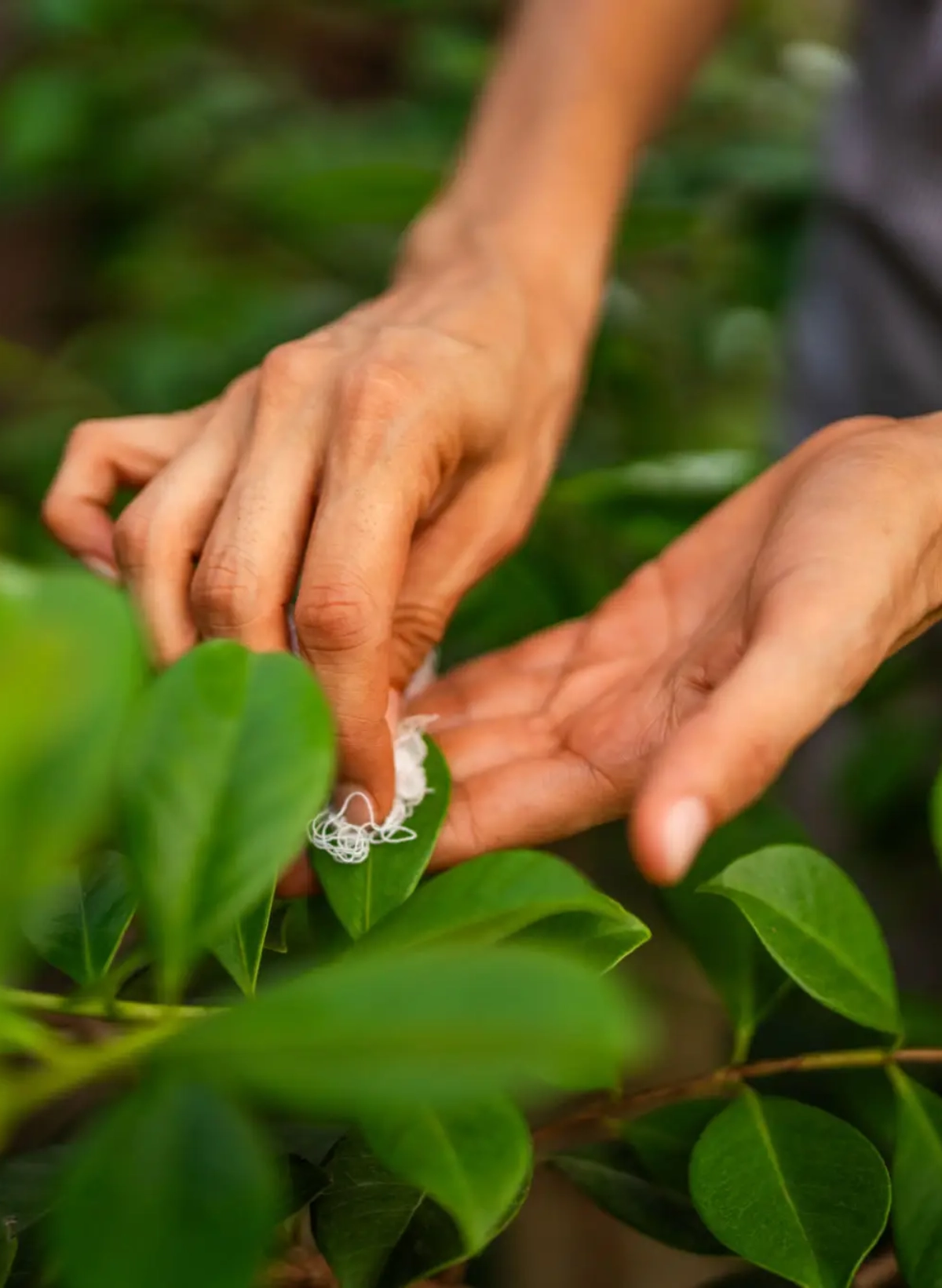
Like other bamboo pests, the damage is mostly cosmetic. Leaves will show irregular yellow spots where the mites have pierced and removed leaf juices. You may also see webbing on the undersides of some leaves.
Spider mites are active during hot, dry summer months and become mostly dormant in fall and winter. You can treat them with biological controls (predatory mites), natural miticidal sprays (neem oil, pyrethrins), or a systemic miticide such as Abamectin. Since Abamectin is a natural fermented product, it may also be considered a natural control.
It is also possible to use predatory mites in conjunction with Abamectin. The predators do not eat sprayed bamboo, only other mites and aphids, so they are not harmed by the treatment.
Predatory Mites That Work Best on Bamboo Mites
Bamboo Pest Treatment & Common Issues
The treatments, when applied as directed, will take care of bamboo mites. Damaged leaves will not heal, so you might think the mites are still present. Since bamboo leaves cycle quickly, the damaged leaves will eventually drop off, and new, healthy leaves will replace them. You can also trim off the most visibly damaged leaves to encourage new growth.
Please follow the application instructions for any treatments you use. Tropical Bamboo cannot calculate mix rates or predatory mite quantities for you.
This is probably the most common issue reported on tropical bamboo. In South Florida, the B. multiplex varieties are the most susceptible. Any bamboo species with dense branch clusters at the nodes can also be affected.
The problem is caused by aphids that secrete a sticky, honey-like substance that accumulates mostly in the branch bases. The sooty mold grows on this secretion. Ants favor the secretion and may farm the aphids, moving them to other parts of the bamboo.
Treat with garden center products labeled for controlling ants and/or aphids. You can also use a pressure washer to remove the mold.
This issue is often ignored by growers because it can be difficult to notice. However, it can become so dense that it completely covers culms in a clump, changing the color to brownish-gray. Regardless, the bamboo often appears unaffected, so treatment is usually a matter of personal preference.
Scale affects many Bambusa species because the culms are glabrous. Some Dendrocalamus, such as giganteus, are also common hosts.
Scale are tiny sucking insects with waxy coverings on their backs. They must be removed physically or treated systemically. Contact insecticides are often ineffective because of the waxy shield. If systemic insecticides are used, the dead insects may remain attached to the culm, branch, or leaf. They can easily be removed, dead or alive, with a pressure washer.
Use garden center systemic products labeled for scale. Insecticidal oils and soaps may also be effective but usually require more frequent applications.
This is a bamboo-specific mealybug, so it should not affect other plants. It was first officially reported in 2002 in Central Florida.
The mealybugs are multi-stage insects and are easily identified when surrounded by sticky white webbing, almost always on new shoot tips (culm tips or branches). If you see unusual white material on shoot tips, peel back the culm leaves, and you should see small pink bodies in the webbing or on the culm.
Sometimes the natural white powdery bloom on new shoots can resemble webbing and cause a false alarm. Be sure to inspect for insects before assuming an infestation. Usually, bamboo shoots develop with no adverse effects. Occasionally, infestations become severe enough that a culm or multiple culms abort. Mealybugs will not kill a bamboo clump, but they can become unsightly and may cause shoots to abort.
The mealybug destroyer (Cryptolaemus montrouzieri) can be effective, at least in the short term. These beneficial predatory insects feed aggressively on active mealybug colonies and are available from many online sources.
The challenge is that mealybugs are multi-stage insects, while the predators remain only as long as live food is available. Once the predators leave, new mealybugs may hatch, requiring additional releases.
Observations in Florida showed that natural predator populations may eventually help balance infestations over time.
Systemic and contact insecticides can be effective, and several products available at garden centers are labeled for mealybugs. A detergent (Ivory dish soap is commonly used) may be added as a surfactant if you foliar spray with a contact insecticide, as the webbing can be difficult to penetrate with a water-based solution.
The key is to thoroughly spray your bamboo—covering all sides, top to bottom. Do not miss any part of the bamboo, and spray out to the drip line on the ground. Reapply every 10–14 days for at least three cycles. Continue even if no new mealybugs are visible, as breaking the life cycle is essential. If treatment is stopped too soon, new insects may appear within a few weeks.
One commonly used homeowner treatment has been tree and shrub products sold at garden centers and home improvement stores. These are often applied by drenching the root zone or spreading slow-release granules around the root zone.
If using any pesticide product, always choose one specifically labeled for your plant and pest, and follow the current product label exactly. Product availability and approved uses can change over time.
For larger collections or commercial settings, growers may use professional pest management programs that rotate treatments to reduce resistance and target different life stages. Because labels, regulations, and approved uses vary by location and over time, Tropical Bamboo recommends consulting a licensed pest professional or extension service for large-scale infestations.
Always use proper protective equipment and follow all safety instructions on the label.
When bamboo growers in the U.S. send photos asking if their bamboo is infected with BaMV, our first response is usually that it is doubtful. This is not a common bamboo disease in the United States.
All legally imported bamboo is checked for BaMV while in quarantine for more than two years. It is a relatively rare virus transmitted only by physical vectors, usually cutting tools. It can be spread through contaminated tools, especially in countries where bamboo is grown in plantations for edible shoots.
Reputable ornamental growers do not distribute infected plants, so most customers should never encounter this disease. Illegally imported bamboo plants or seeds may increase the risk of introducing the virus.