This section lists the tropical bamboo plant varieties we have in production. They
are all tropical, or sub-tropical, clumping bamboos and are generally not
cold-hardy like the temperate, running bamboos. Some, the sub-tropicals, can
tolerate freezing temperatures for short periods. Check the minimum
temperatures listed on each species description as a guideline for which
species can grow unprotected in your area.
Use our Search Bamboo page to find something specific.
For three years, we kept this little beauty in a shady, protected area of our test field. Three wasted years.
It was originally imported in 2014 from western China. Because of the genus and its high altitude home we were certain it would quickly die in our hot, humid summers so we picked the coolest area in our field. The bamboo survived but was never happy. In late 2019, we decided to move it to a bright, sunny area near our display garden. We were certain it would either thrive or die and we were pleasantly surprised when it quickly turned into a gorgeous little bamboo!
We've now discovered some published information on the species and have learned that it's endemic to southern Taiwan, not western China. No wonder it's at home in the South Florida sun. This is one of the articles:
Article with species details.
This will be one of the few, small tropical bamboos. Ours is about 4' tall and may eventually reach 10' in S.Florida. More likely 6'-7' tall at maturity. This bamboo will be perfect in containers as a patio bamboo, it will fit in small gardens, and it will work well along pathways or in the foreground of larger gardens. Full sun to part shade. Availability will be summer of 2020 as we've been panic-propagating since late 2019. 2022 UPDATE: Now available for sale, very limited stock. We don't yet know the cold hardiness but are guessing it will handle - high 20s F for short periods. Minimum USDA zone: 9a Click here to find zone.
ABS characterizes this plant as viney but it can manage without support. It is growing nicely, fairly delicate and bushy with droopy culm tips, in South Florida. Spidery branches that attach to surrounding plants (if any are within reach). This is a tight mountain clumper from Yunnan, China. Professor Xue Jiru introduced it to the U.S.A. It matures to 30' tall in China but probably no more than 15' in S.Florida. It does seem to have some cold hardiness - mid 20s F with no problems. Minimum USDA zone: 8b. Click here to find zone.
A green culmed, small leafed bamboo. Originates from the Arnhem Land in the Northern Territory of Australia. Traditionally used by the Aboriginals for making didgeridoos and structures.
The new shoots are edible and have a very distinct lime green color - unlike any other bamboo.
Its growth habit is somewhat scruffy. Not often used as an ornamental landscape bamboo, but does produce very strong bamboo timber poles. Poles are reportedly resistant to termites that are plentiful in its native region.
More for the collector or timber grower.
Imported April/2011 into USDA quarantine and released to us in 2012.
Minimum USDA zone 10.
Click to find your zone.
Native to New Guinea, the Moluccas, and Sangihe Island. Often found on limestone. A thin-walled, tight clumping, reed-like shrub with large leaves/no low branching. About 5% of the leaves are variegated. Persistent culm sheaths create an ornamental effect. Grows 20' tall with 1" diameter culms. Minimum temp 30 degrees F. Minimum USDA zone: 9b.Click here to find zone.
From India. Strong, used for construction, paper pulp, crafts, and edible shoots. When mature, the primary branch at each node is almost perpendicular to the culm - in India, this has been utilized to quickly create a single pole ladder.
This species is representative of many Indian bamboos in that it's much more useful than ornate.
50' tall with 4" diameter culms. Min temp 24 degrees F. Min USDA zone: 9b. Click here to find zone.
Fast-growing, thick-walled, soft. Lower branches are long, wiry, and armed with thorns. Edible shoots. Used for paper in India. Very small leaves. There are many seedling varieties, or cultivars, of this species. The seeds of the cultivar listed here were germinated at Fairchild Tropical Garden, Miami.
The species name 'Bambusa bambos' (L.) Voss takes priority over the taxonomic synonym 'Bambusa arundinacea' (Retz.) Willd. and is the correct name to use, although Bambusa arundinacea remains the named representative of the type of the conserved genus Bambusa.
May grow up to 50' tall with 3" diameter culms in Florida. Min temp. 30 degrees F. Min USDA zone: 9b. Click to find your zone.
A timber bamboo with large, outwardly-curving culms and edible shoots. This was once a very popular bamboo in the USA but people lost interest when, in the 1990s, all plants tested were discovered to be infected with BaMV. Our stock was Re-imported from China in 2012, quarantined/tested by the USDA/APHIS, and was released to us in 2013. It may be the only standard Bambusa beecheyana stock in the USA that is free of the Bamboo Mosaic Potax Virus (BaMV).
Culms generally arch and are covered with white powder and when young. Will grow to 65' tall with 5" diameter culms in Florida. Reported to be cold-hardy to 21 degrees F. Min USDA zone: 8b. Click here to find zone.
Somewhat similar to the standard Beechey but without the Bamboo Mosaic Potex Virus. Until we imported the standard B.beechey in 2012, this pubescens variety was the only virus-free option in the USA. Now we have both options - both tested virus-free. Culms generally arch and are covered with white powder and when young. Will grow to 45' tall with 3" diameter culms in Florida. Reported to be cold-hardy to 21 degrees F. Min USDA zone: 8b. Edible shoots.Click here to find zone.
The real thing!.....OK, let me explain...
This bamboo species name has been circulating in South Florida for many years. Whenever we heard that someone was growing it, we investigated and discovered it was really Dendrocalamus validus.
In 2013, I finally imported the true species from China (Hua'an). It was delayed in USDA quarantine but was released to us in March/2015.
The species grows at least 50' tall. The new shots are mostly green, unlike the bright red/orange shoots of D.validus.
May be cold-hardy to 27 degrees F. Min USDA zone: 9b. Click here to find zone.
In India and Indonesia, a tall, thorny bamboo. It is used for construction, baskets, and edible shoots. At the base of the culms, wall thickness is mostly solid, especially in dry areas or poor soil. This bamboo species grows in humid or dry tropical areas along river banks, hill slopes, and freshwater creeks. It often occurs at low or moderate altitudes.
In South Florida, it seems to grow more bushy than tall. Makes a great thorny hedge to keep out unwanted wildlife or trespassers. Will grow to about 30' tall with 1" diameter culms. Min. temp. 28 deg F. Min USDA zone: 9b. Click here to find zone.
A small-growing bamboo with a delicate appearance. Fine leaves that droop to the ground when young. Can be used as a privacy screen in applications where a shorter bamboo is required. Occasionally persistent culms sheaths.
Will grow to 25' tall with 1" diameter culms. Min. temp. 27 deg F. Min USDA zone: 9b. Click here to find zone.
Just as the standard B.boniopsis has begun to surge in popularity, this striated version arrives in the USA. B.boniopsis has proven itself as one of the best options as a hedging/screening bamboo. Small leaves, vigorous growth, and dense branching adds up to a bamboo that can be trimmed and shaped into a well-groomed hedge. This new 'Yellowstripe' version adds a bit of extra pizzazz on the lower culms. It was collected in 2013 from the South China Botanic Garden, Guangzhou, and sent to USDA quarantine. In March/2015 it was released to us and is now growing in our test field.
Will grow to 20' tall with 1" diameter culms. Min. temp. 27 deg F. Min USDA zone: 9b.Click here to find zone.
Dense clumper with medium/large leaves. More of a collector's bamboo than for general landscape use. From Burma.
Can grow to 30'tall with 1.5" diameter culms in Florida. Minimum temp 32 Deg F. Min USDA zone: 9b. Click here to find zone.
I first took note of this species 15 years ago in the book 'A Compendium of Chinese Bamboo'. During one of several collection trips to China in 2012, it finally was sent to USDA quarantine. In March/2013, it was released to us and is now being test-grown at Tropical Bamboo Nursery & Gardens.
In South China, it grows in appearance like a dwarf combination of Bambusa chungii and Bambusa textilis gracilis. It averages 15' in height with thin, finger-sized culms. Used in china for weaving.
If it performs well in South Florida, we anticipate it will work well as a small privacy screen or a small-garden feature plant.
Cold-hardiness is unknown at this time but we're guessing it should handle temperatures in the range of the aforementioned B.chungii and B.textilis.
MIn USDA zone: 9a. Click here to find zone.
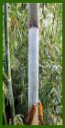
A stunning, mystical bamboo. Thin-walled culms are covered with persistent, dense white bloom, giving them a pale blue appearance. Slightly open clumper that will grow to at least 30' tall with 2" dia. culms. This rare Chinese import cleared U.S.D.A. quarantine in the 1990's. Also called Emperor's Blue Bamboo & White Bamboo.
Min. temp 21�F. Min USDA zone: 8b/9a. Click here to find zone.